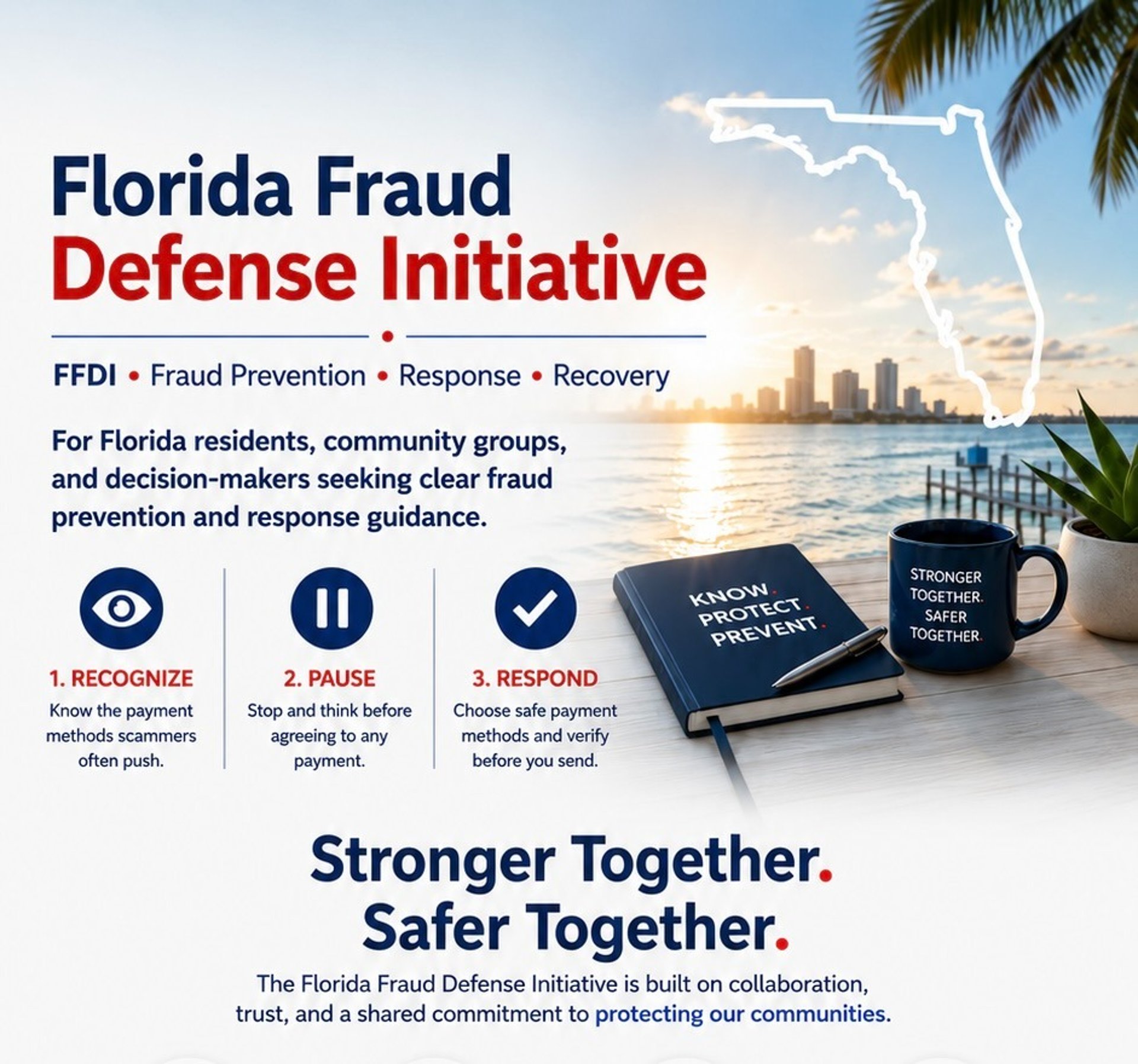
FLORIDA FRAUD DEFENSE INITIATIVE
For Florida residents, community groups, and decision-makers seeking clear fraud prevention and response guidance.
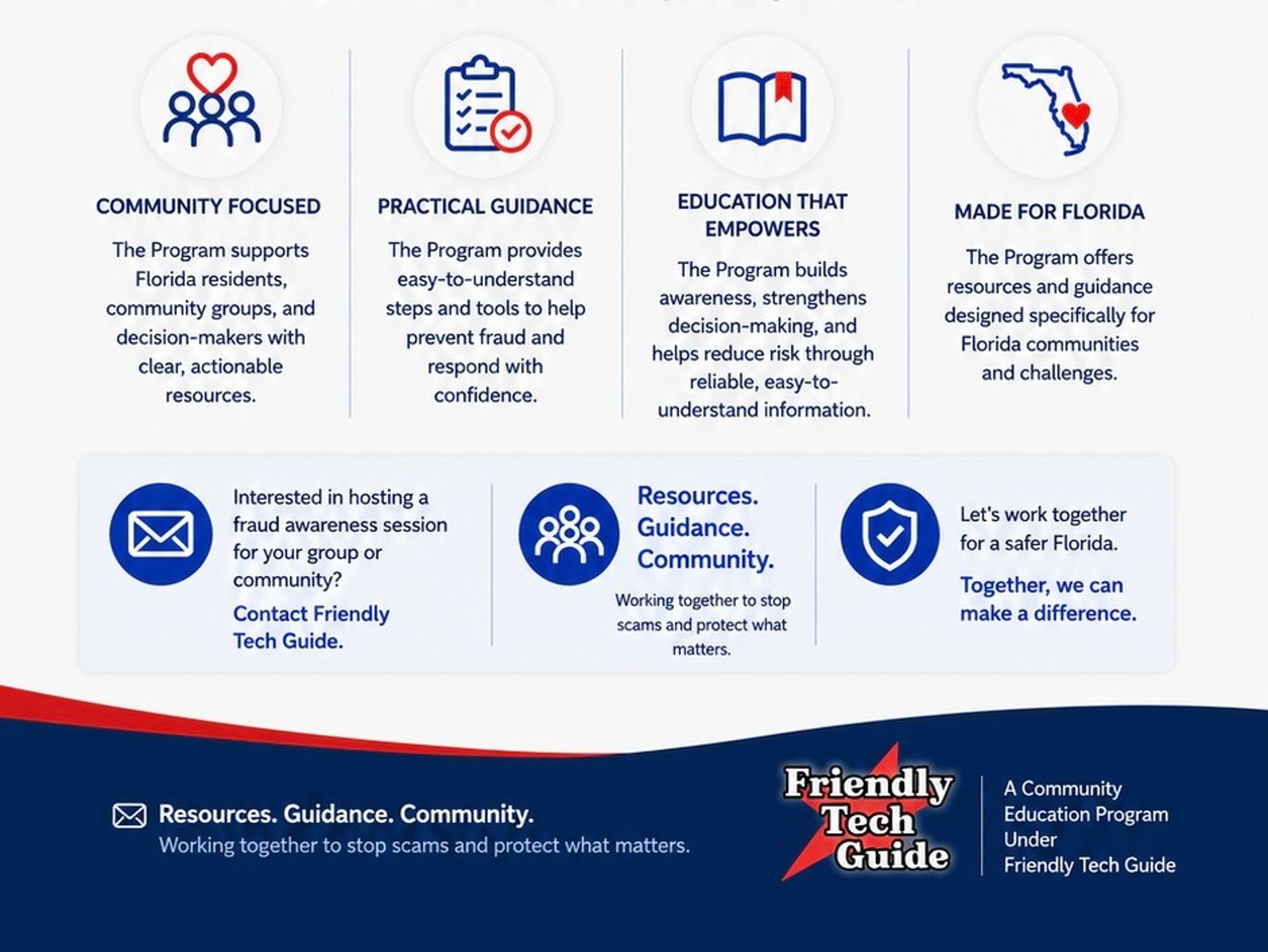
A Community Education Program Under Friendly Tech Guide
The Florida Fraud Defense Initiative provides practical, structured guidance on fraud prevention and response for Florida residents and community organizations.
Our focus is simple:
Awareness.
Prepared response.
Community education.
Interested in hosting a fraud awareness session for your group or community? Contact Friendly Tech Guide.

How to Recognize a Phone Scam in 10 Seconds
Phone scams are common and increasingly sophisticated.
According to federal reporting, fraud losses in the United States continue to rise each year, with Florida consistently ranking among the states with the highest reported losses.
While tactics evolve, most fraudulent calls share consistent warning signs. Recognizing those signs early can prevent financial loss and unnecessary stress.
Here are the signals to listen for.
1. Immediate Urgency
Many reported scam cases begin with artificial urgency.
Statements such as:
“This is your final notice.”
“Your account will be closed today.”
“Law enforcement is on the way.”
are designed to trigger fear before logic.
Consumer protection agencies regularly advise that legitimate institutions do not demand immediate payment or sensitive information without written documentation and verification.
Pressure is often the first indicator of fraud.
2. Unusual Payment Requests
Federal consumer reports repeatedly identify gift cards, wire transfers, and cryptocurrency as common payment methods used in scam activity.
Government agencies, banks, and utility companies do not require payment through these methods to resolve urgent matters.
If the payment method feels irregular, pause before responding.
3. Requests for Sensitive Information
Fraud reports frequently involve callers requesting:
Social Security numbers
Full banking details
Account passwords
One-time verification codes
If you did not initiate the call, you are not obligated to provide this information.
You may always end the call and contact the organization directly using the official number listed on its website.
4. Caller ID Is Not Verification
Modern spoofing technology allows scammers to alter the number displayed on your phone.
Consumer protection agencies consistently warn that caller ID alone should not be treated as proof of legitimacy.
A Simple Response Strategy
When in doubt:
Pause.
End the call.
Verify independently.
Taking a few minutes to confirm information can prevent significant financial loss.
Why This Matters in Florida
Florida consistently reports high levels of fraud activity, particularly affecting retirees and households on fixed incomes.
Florida's Department of Financial Services offers a statewide Fraud Free Florida platform with official reporting and prevention resources.
As our communities grow, so does the sophistication of financial scams. The Florida Fraud Defense Initiative operates as a community education program under Friendly Tech Guide. Its mission is to reduce preventable financial losses through awareness and practical guidance.
Community organizations interested in hosting a short informational session may contact Friendly Tech Guide for additional information.
What To Do in the First 24 Hours After Fraud
Discovering that you may have been a victim of fraud can feel overwhelming.
The first reaction is often panic. That reaction is understandable, but early action is more important than emotion.
According to federal consumer reporting, response speed significantly impacts financial recovery outcomes. The first 24 hours matter.
Here is a clear, structured approach.
Step 1: Stop All Contact Immediately
If the fraud involved a phone call, text, email, or online message:
• End communication
• Do not attempt to argue
• Do not try to “recover” money through the same channel
Fraudsters often continue engagement to extract additional funds.
Stopping contact helps prevent further loss.
Step 2: Contact Your Financial Institution
If money was transferred or account access was involved:
• Call your bank or credit card company directly
• Use the official phone number listed on the back of your card or on the institution's website
• Explain that you believe fraud has occurred
• Ask for a freeze or fraud alert on affected accounts
Many institutions have rapid-response protocols for fraud when notified promptly.
Time is critical.
Step 3: Change Passwords Immediately
If login credentials were shared:
• Change passwords for the affected account
• Change passwords for email accounts
• Enable two-factor authentication where available
Email accounts are especially important. Access to email can allow scammers to reset other accounts.
Step 4: Place a Fraud Alert or Credit Freeze
If Social Security numbers or identifying information were exposed, consider:
• Placing a fraud alert with one of the three major credit bureaus
• Initiating a credit freeze
Consumer protection agencies recommend taking early action to prevent fraudulent opening of new credit accounts.
A credit freeze can be lifted later if needed.
Step 5: Document Everything
Write down:
• Dates and times
• Phone numbers used
• Amounts transferred
• Names or titles given
• Screenshots of communications
Documentation supports investigations and potential recovery efforts.
Step 6: File an Official Report
Consider filing a report through:
• Your local law enforcement agency
• Federal consumer reporting systems
While not every case results in direct recovery, reporting contributes to broader fraud tracking efforts and may assist financial institutions in their review process.
Step 7: Slow Down and Assess
Fraud often triggers shame or embarrassment. That reaction is common.
Fraud schemes are designed to bypass logic and exploit urgency. Many responsible, intelligent individuals are affected each year.
The focus now is containment and prevention of further harm.
Why Early Action Matters
Federal reporting consistently shows that rapid response improves the likelihood of account protection and reduces cascading financial damage.
The first 24 hours are about:
Containment.
Account protection.
Documentation.
Prevention of additional loss.
Florida Fraud Defense Initiative
The Florida Fraud Defense Initiative operates as a community education program under Friendly Tech Guide. Its mission is to provide structured, practical guidance that Florida communities can use immediately when fraud occurs.
Prevention is ideal.
A prepared response is essential.
Community organizations interested in hosting a structured fraud response session may contact Friendly Tech Guide for additional information.


The RPR Method:
Recognize, Pause, Respond
A simple way to stop scams in real time, even when you feel rushed or stressed.
Recognize: Something feels off
Pause: Stop. Do not click. Do not pay.
Respond: Verify using a number or website you already trust.
Call or text Friendly Tech Guide for assistance.
The 10-second version
Recognize the red flags.
Pause before you act.
Respond by verifying through a trusted source.
If someone is pushing urgency, that is your cue to use RPR.
Ever notice how the moment you slow down, the story starts to fall apart?
Why RPR works when panic kicks in
Scams rely on speed and emotion. They want you to feel rushed, scared, or excited so you act before you think.
A short pause breaks the spell. Once you slow the moment down, the scam has a harder time holding together.
Scripts remove guesswork. When you know what to say, you stay in control, even under pressure.
Recognize: Spot the red flags
If you learn the patterns, most scams become obvious.
The most common red flags
Urgency: “Do this now”
Secrecy: “Do not tell anyone”
Fear: “Your account is locked” or “You will be arrested”
Weird payment: gift cards, crypto, wire transfer
New link or new number you have never used before
They want a code you received by text or email
They want remote access to your device
The story sounds official but feels off
A simple Recognize question
Would a real bank, agency, or company ask me to do this in a rush?
Pause: Create a safety gap
You do not need to decide right now. You need to slow the moment down.
The Pause protocol
Stop talking
Do not click anything
Do not share codes or passwords
Take one breath
Say one sentence, then end the contact
Script you can use right now:
“I can’t do this right now. I will verify and call back.”
If they get angry when you pause, that is a sign you are doing the right thing.
Respond: Verify and protect yourself
Respond does not mean comply. It means take the next safe step.
The safe verification rule
Only verify using a number or website you find yourself, not what they give you.
Copy and paste scripts
Phone scam script
“I am going to hang up and call the company back using the number on my statement or their official website.
Text or email link script
“I do not use links in messages for account issues. I will log in through the official app or website.”
Family emergency script
“I love you. I am calling you back on your normal number now.”
Contractor or disaster repair script
“I will only work with verified contractors. I will check licensing and references before any deposit.”
Four common scam setups and how RPR stops them
Scenario 1: Bank fraud alert text
Recognize: urgency plus a link
Pause: do not click
Respond: call the bank using the number on your card
Scenario 2: Package delivery message
Recognize: random link and vague tracking
Pause: do not enter personal info
Respond: go to the carrier website directly
Scenario 3: Government threat call
Recognize: fear, fines, or arrest language
Pause: hang up
Respond: verify through official government websites
Scenario 4: Tech support pop-up
Recognize: scary warning and a phone number
Pause: do not call
Respond: close the browser and get real help
What not to do
Scammers usually want three things.
Your speed
They want you to act before you think.
Your secrets
They want codes, passwords, and personal information.
Your money path
They want a payment method that cannot be reversed.
If you already clicked or paid, do this next
First, stop contact. Do not argue. Do not negotiate. Just end the conversation.
Then take these steps:
Stop contact with the scammer
Secure your accounts and devices
Contact your bank or card issuer
Save evidence: screenshots, numbers, emails, and receipts
Start your 24-hour checklist
Read next: What to do in the first 24 hours after fraud
FAQ
What if they say they will close my account today?
That is a pressure tactic. Use RPR. Hang up and call the company back using the number on your statement, card, or official website.
Should I ever read a code to someone?
Almost never. Codes are commonly used to take over accounts. If someone asks for a code, treat it as a red flag and verify it with a trusted number.
How do I know the real number to call?
Use a number you already trust, like the number on the back of your card, your monthly statement, or the official website you type in yourself.
What if it is someone I know and their account got hacked?
Pause and verify through another channel. Call their normal number, or ask a question only they would know. If they refuse, end the contact.
What if I am not sure if it is a scam?
If you are not sure, that is enough reason to pause. You can always verify safely. Real companies will not punish you for being careful.
Call, text, or email to book a help session.
Personalized technical assistance at your convenience.
© 2025. All rights reserved.