How to Recognize a Phone Scam in 10 Seconds
Use this 10-second test to spot scam calls fast: urgency, payment pressure, requests for codes, and caller-ID spoofing. When in doubt: hang up and verify independently. Categories: FFDI; Fraud Prevention
Friendly Tech Guide
2/25/20263 min read
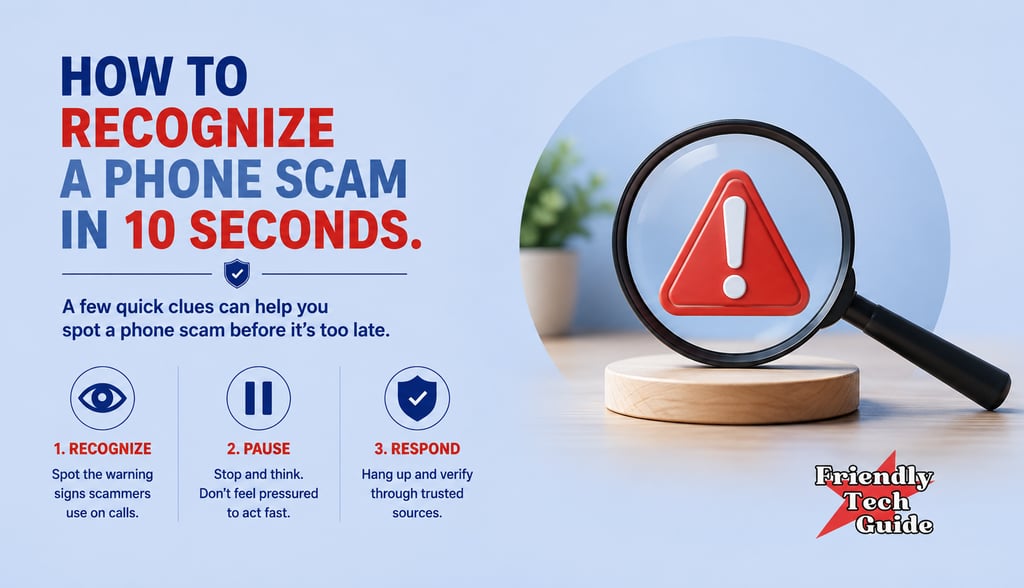
Phone scams are very common and getting more sophisticated each day.
Recent federal reporting shows consumer fraud losses remain extremely high, and Florida is consistently among the top states for reported complaints in national reporting. That’s why fast recognition matters.
Use this 10-second test to decide what to do next.
THE 10-SECOND TEST
If the caller does any one of the following, treat it as high risk:
• They create urgency (“final notice,” “today only,” “act now”)
• They push payment pressure (especially gift cards or cryptocurrency)
• They ask for codes or sensitive access (one-time codes, passwords, remote access)
• They claim caller ID proves it’s real
If any of these appear, your safest move is simple: hang up and verify independently.
IMMEDIATE URGENCY
Many scam calls start with artificial urgency.
Examples:
• “This is your final notice.”
• “Your account will be closed today.”
• “Law enforcement is on the way.”
Urgency is designed to trigger fear before logic.
Legitimate organizations will allow time for you to verify through official channels. Pressure is often the first indicator of fraud.
UNUSUAL PAYMENT REQUESTS
If someone pressures you to pay, move money, or “fix” a problem immediately, pause.
Two major red flags:
• Gift cards (scammers tell you to buy them and read the numbers)
• Cryptocurrency (scammers demand it because it’s hard to reverse)
If you hear “gift card” or “crypto,” assume it’s a scam and end the contact.
REQUESTS FOR SENSITIVE INFORMATION OR CODES
Scam calls often ask for things you should never share, especially when you didn’t initiate the contact, such as:
• One-time verification codes
• Passwords
• Account login details
• Remote access to your device
A simple rule: verification codes are for you, they are not for anyone who calls you.
If someone asks for a code, stop engaging and verify independently.
CALLER ID IS NOT VERIFICATION
Caller ID can be faked.
Scammers use caller-ID spoofing to make the call look like it’s coming from a real company or agency. That means a familiar number on your screen is not proof that the caller is legitimate.
Treat caller ID as a clue, but not a confirmation.
A SIMPLE RESPONSE STRATEGY
When in doubt:
Pause
End the call
Verify independently
Verification means using a channel you choose, not one they provide.
Use:
• The number on the back of your card
• A number on your statement
• The official app you already use
• A website address you type in yourself
Do not use:
• Links they sent
• Numbers they gave you
• QR codes they sent
Taking a few minutes to confirm can prevent major loss.
WHY THIS MATTERS IN FLORIDA
Florida residents are frequently targeted, and Florida consistently appears among the top states in national complaint reporting.
For Florida-specific prevention and reporting resources, the Florida Department of Financial Services provides Fraud Free Florida.
The Florida Fraud Defense Initiative is a community education program under Friendly Tech Guide. Our mission is to reduce preventable financial losses through awareness and practical guidance.
Community organizations interested in hosting a short informational session may contact Friendly Tech Guide for more information.
SOURCES (OFFICIAL GUIDANCE)
FTC — New FTC data: reported consumer fraud losses reached $12.5B in 2024
FBI — Internet Crime Report press release (Florida among top states for complaints; phishing/spoofing common)
FCC — Caller ID Spoofing (caller ID can be falsified)
FTC — Gift card scams (government agencies don’t demand gift cards)
FTC — Cryptocurrency scams (only scammers demand crypto payments)
FTC — Verification code scam alert (don’t share one-time codes)
https://consumer.ftc.gov/consumer-alerts/2024/03/whats-verification-code-why-would-someone-ask-me-it
FTC — How to avoid imposter scams (verify through contact info you know is real)
Florida Department of Financial Services — Fraud Free Florida
DISCLAIMER: This is general prevention guidance, not legal advice. If you believe money or accounts are at immediate risk, end the contact and use official channels you navigate to yourself (for example, your bank’s official support number from your card or statement).
If you found this information helpful, please forward it to someone who could benefit.
Personalized technical assistance at your convenience.
© 2025. All rights reserved.