
How to Verify Any Call or Text Without the Risk
Learn the callback rule. It is a simple, repeatable habit that helps you pause and verify if a call, text, or email is really from a trusted organization.
FLORIDA FRAUD DEFENSE INITIATIVEFFDIFRAUD PREVENTIONSCAM AWARENESSPHONE SCAMS
Friendly Tech Guide
4/15/20263 min read
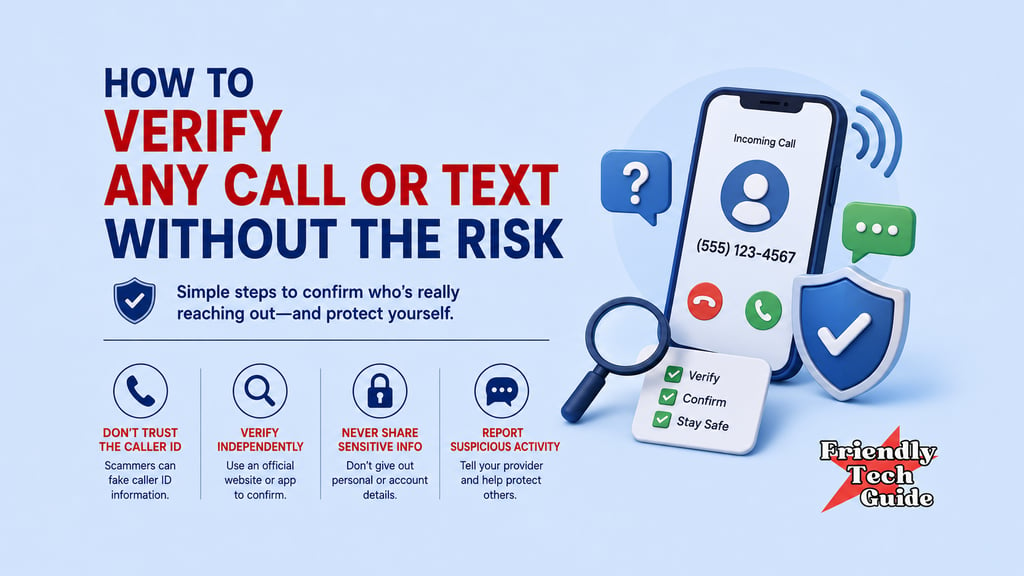
If you want one scam prevention habit that works across bank calls, account locked texts, delivery messages, and tech support warnings, use this:
The Callback Rule.
The Callback Rule is not about being suspicious of everything. It is about staying in control when someone else is trying to rush you.
The Callback Rule, in plain language
Pause, step out of the conversation, and verify through a number you trust.
In practice, that usually means:
Pause
Hang up, or stop replying
Call back using a number you found yourself
Why this rule matters now
Many scams are imposter scams. The scammer pretends to be someone official: a company, a bank, a government agency, a delivery service, tech support, or even a person you know.
Two common tactics show up again and again:
Urgency: do this right now
Control: stay on this call, use this link, do not contact anyone else
The callback rule breaks both tactics by giving you a clean exit and a safer way to check what is real.
Recognize. Pause. Verify through a trusted path. Respond when calm.
That sequence is the whole system.
When to use the callback rule
Use it any time:
You did not start the conversation
The message involves fraud, suspicious activity, a refund, an account locked, a security alert, or a payment due
Someone asks for personal information, money, gift cards, crypto, or remote access
You feel rushed, confused, or pressured
Pressure is not proof. Pressure is a signal to pause.
The household rule
We do not verify through incoming calls, texts, or emails.
We pause and call back through a number we trust.
If you teach that one line to your household, you remove a huge amount of leverage for scammers.
A short script you can say out loud
Use a single sentence. Keep it calm and boring:
“I'm going to pause and verify through a trusted number. If this is real, I'll contact you after I confirm it."
Then stop talking. Hang up. Or stop replying.
How to do the callback rule
Step 1: Recognize
Notice the pattern: unexpected contact plus urgency plus a request.
Step 2: Pause
Do not share information.
Do not click.
Do not send money.
Do not move the conversation forward.
Step 3: Verify through a trusted path
Use a path you control. Examples:
Open the official app you already use, not through their link.
Type the website address yourself, not through their link.
Call a known number, such as:
a. the number on the back of your card
b. the number inside the official app
c. a number from an official website you typed in yourself
Key rule: do not use a number they provide, even if it sounds right.
Step 4: Respond when calm
If the issue is real, you can handle it without pressure.
If it is a scam, you have avoided giving the scammer what they wanted.
Common examples
1. “This is your bank. There is fraud.”
Pause. Hang up. Call the number on the back of your card.
2. “Your package is held. Pay a small fee.”
Pause. Do not click. Verify by going to the carrier’s official site or app that you opened yourself.
3. “Your account is locked. We sent a code. Read it to me.”
Pause. Do not share codes. Verify by signing in directly through the official app or website.
4. “Tech support: your computer is infected. Call now.”
Pause. Do not call the pop-up number. Step out and get help only through a trusted provider you chose.
What to do if they keep pushing
A scammer may try to keep control by saying:
“If you hang up, your account will be frozen.”
“You cannot call the number on your card.”
“This line is secure, stay with me.”
Treat that pushback as confirmation to pause and verify independently.
You do not need to convince them.
You just need to exit the conversation.
A calm close
The callback rule is a safety habit. It works because it removes the scammer's advantage: speed and control.
Recognize.
Pause.
Respond when calm, and verify through a trusted source.
Use it once or twice, and it becomes automatic.
If you found this information helpful, please forward it to someone who could benefit.
Friendly Tech Guide provides general education and support. We are not a law firm, bank, or government agency. For legal or financial advice, contact a qualified professional. If you believe you are in immediate danger, call local law enforcement.
Sources
Personalized technical assistance at your convenience.
© 2025. All rights reserved.