
If a Caller Says Your Bank Needs You To Move Money To Protect It, Pause
If someone says your bank needs you to move money through a payment app to protect it, pause. Learn the red flags, the safest response, and what to do if you already sent money.
FLORIDA FRAUD DEFENSE INITIATIVEFFDIFRAUD PREVENTIONSCAM AWARENESSPHONE SCAMS
Friendly Tech Guide
4/6/20263 min read
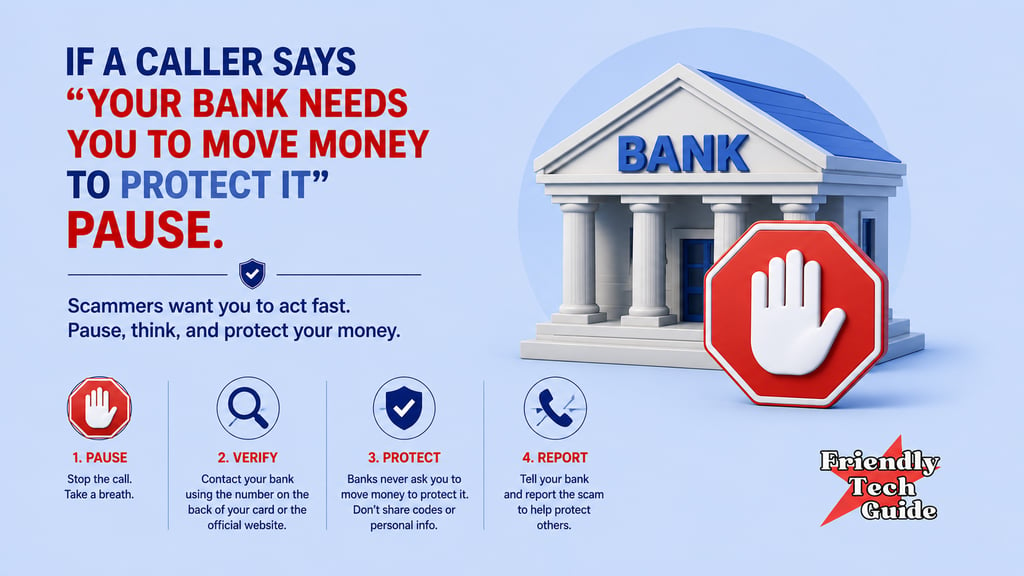
Most bank fraud scams are not trying to protect your money. They are trying to get you to move it before you have time to think.
If someone calls, texts, or emails and says you need to move money through Zelle, Cash App, Venmo, or another payment app to keep it safe, pause. That is a major scam red flag.
The safest move is simple: step out of the conversation and verify through a trusted path you control.
What makes this a scam
These scams often sound polished and urgent.
You may hear things like:
There is fraud on your account.
Your money is at risk.
You need to move it to a safe account right now.
Stay on the phone while we help you.
Read me the code we just sent you.
They may know part of your information. They may sound calm and professional. The phone number on your screen may even look familiar.
That does not make the call real.
A real bank can help you after you hang up and contact them through a number or app you already trust.
A scammer needs you to stay in the conversation.
The safest response
Use this sequence:
Pause.
Do not send money.
Do not test a small transfer.
Do not use the number or link they gave you.
Contact your bank through a trusted path you control.
That means opening your bank app the normal way, or calling the number on the back of your card or from a statement or website you know is real.
Why payment apps show up in these scams
Payment apps are familiar, fast, and easy to use. Scammers use that speed to keep you moving before you verify anything.
The problem is not the app itself.
The problem is anyone trying to control how and when you move money under pressure.
If a stranger tells you to move money to protect it, the payment method is part of the scam.
If caller ID looks like your bank
Caller ID is not proof.
Phone numbers can be spoofed. A call can look real and still be fake.
That is why the callback rule matters:
End the conversation.
Then contact your bank using a number you already trust.
Do not trust the number that called you.
Do not trust the number in a text.
Do not trust the number they tell you to call back.
A short script you can use
You do not need a perfect speech. You need one calm sentence.
Use this:
“I am not moving money right now. I am going to contact my bank directly using a number I already trust.”
Then end the conversation.
You do not need to argue.
You do not need to prove anything.
You do not need to stay on the line.
What to do if you already sent money
Act quickly, but stay calm.
Contact your bank using a trusted number and explain what happened.
Contact the payment app through its official app or official website.
If you shared a verification code, password, or clicked a suspicious link, secure your email and financial accounts right away.
Save screenshots, transaction details, phone numbers, and messages.
Report the scam through official channels.
The sooner you act, the better.
One habit that protects you
You do not need to memorize every scam story.
You need one repeatable habit:
Recognize the pressure.
Pause before you act.
Respond through a trusted path you control.
That habit will protect you in more situations than any single warning ever could.
If someone tells you to move money to protect it, pause. Your next step is not to obey.
Your next step is to verify.
If you found this information helpful, please forward it to someone who could benefit.
Disclaimer
Friendly Tech Guide provides general education and support. We are not a law firm, bank, or government agency. For legal or financial advice, contact a qualified professional. If you believe you are in immediate danger, call local law enforcement.
Sources
Personalized technical assistance at your convenience.
© 2025. All rights reserved.