What To Do Before You Click: A Simple Scam Safety Checklist
Most scams start with a message that pushes you to act fast. This simple checklist helps you pause, verify through official channels, and respond more safely using one clear framework: Recognize. Pause. Respond.
FRAUD PREVENTIONFFDISMISHINGPHONE SCAMSSCAM LINKSSCAM PREVENTIONONLINE SAFETYFLORIDA FRAUD DEFENSE INITIATIVEPOPUP SCAMSDMV SCAMSGIFT CARD SCAMSPHISHINGSCAM AWARENESSVERIFICATION CODE SCAMS
Friendly Tech Guide
3/9/20264 min read
Most scams do not begin with a stranger in a dark alley. They begin with a text, an email, a social media message, or a pop-up that tries to make you act fast.
That is the point. Scammers want speed. They want panic. They want you to click before you think.
The good news is that a safer response does not have to be complicated. At Friendly Tech Guide, we use a simple idea: Recognize. Pause. Respond.
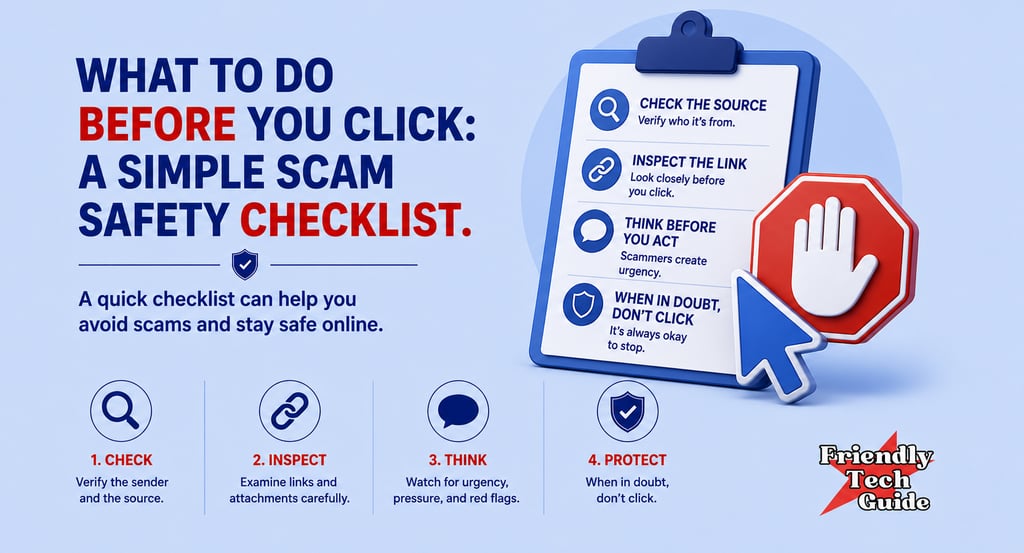
Before you click, call, reply, or send money, pause and walk through this checklist.
Pause before you act
If a message creates a strong reaction, pause right there. If it makes you feel scared, rushed, excited, or confused, treat that as a warning sign.
Scammers often pretend there is a problem that must be fixed right now. Other times, they promise a prize, a refund, or a special offer. In both cases, the goal is the same: to push you into a quick decision.
Give yourself a moment. Put the phone down. Read the message again. A short pause can save you from a big mistake.
Check the sender carefully
Look closely at who sent the message. Not quickly. Closely.
Does the email address match the company name? Is the phone number unfamiliar? Does the message come from a random address while claiming to be your bank, Amazon, Apple, Medicare, or a delivery service?
Scammers count on people seeing a familiar logo or brand name and trusting the message without checking details. A message can look official and still be fake.
If anything feels off, treat it as suspicious until you verify it.
Do not trust urgency
Urgency is one of the oldest scam tools in the book. You may see messages like these:
Your account will be closed today.
A charge has been detected.
Your package cannot be delivered.
Your grandchild needs help right now.
You must act in the next 10 minutes.
Ask yourself a simple question: Why would a real company demand immediate action through a surprise message?
Legitimate businesses may send alerts. Scammers use pressure to keep you from thinking clearly. The more urgent it feels, the more careful you should be.
Never use the contact information inside the message
This is one of the most important steps.
Do not click the link in the message.
Do not call the number in the message.
Do not reply to the message to verify anything.
Instead, go to the source yourself. Open the official app. Type the official website into your browser. Use the phone number from the back of your card, your statement, or the company website you know is real.
Why does this matter? Scam messages often give you fake links and fake phone numbers that lead directly to the scammer.
Watch for strange payment requests
Scammers love payment methods that are fast and hard to recover.
Be especially careful if someone asks for payment by gift card, wire transfer, cryptocurrency, or unusual payment apps that do not match normal business practice.
A real company, government agency, or utility provider is not likely to demand payment in gift cards. That should be your signal to pause and verify before doing anything else.
If the payment method feels strange, the situation probably is too.
Go to the official website or app
When in doubt, leave the message behind and start fresh.
If the text says there is a problem with your bank, go to your bank's official app.
If the email says there is an issue with Amazon, log in through the real Amazon site.
If the message says there is a missed delivery, go to the shipping company's official website and check there.
Do not let the message lead you. You lead the process.
That one change can protect you from many common scams.
Ask someone you trust
Still unsure? Pause and get a second opinion.
Call a friend, family member, or someone you trust before you do anything. Many scams lose their power the moment another person looks at them.
Why? Because the scam depends on isolation, confusion, and speed. A second set of eyes can break that cycle fast.
What to do if you already clicked
First, do not panic. People catch scams at different stages, and quick action still helps.
If you clicked a suspicious link, close the page immediately.
If you entered a password, change it right away.
If you used that same password anywhere else, change it there, too.
If you entered bank or card information, call the bank or card company using the official number.
If you downloaded something suspicious, run a trusted security scan and get help if needed.
If you sent money, contact your financial institution as soon as possible.
The faster you respond, the better your chances of limiting the damage.
Keep it simple: Recognize. Pause. Respond.
You do not need to memorize every scam in the world. New versions show up all the time. What helps is having a simple response pattern you can trust.
Recognize the pressure.
Pause before acting.
Respond through official, verified channels.
That simple habit can protect you from a lot of trouble.
Scammers want rushed decisions. You do not have to give them one.
Sources:
This article draws on official consumer guidance from the Federal Trade Commission:
Forward this to one person you care about. If you can help a parent do this once, you prevent a lot of pain later.
Disclaimer: This is general information for fraud prevention and response. It is not legal advice. If you believe a crime occurred or you are in immediate danger, contact your bank and local authorities using official contact methods.
If you found this information helpful, please forward it to someone who could benefit.
Personalized technical assistance at your convenience.
© 2025. All rights reserved.