
No, Your Boss Is Not Asking for Gift Cards
Scammers impersonate bosses and CEOs to trick employees into buying gift cards. Learn the signs of this workplace scam and how to safely verify requests.
FLORIDA FRAUD DEFENSE INITIATIVEFFDIFRAUD PREVENTIONSCAM AWARENESSGIFT CARD SCAMS
Friendly Tech Guide
4/27/20265 min read
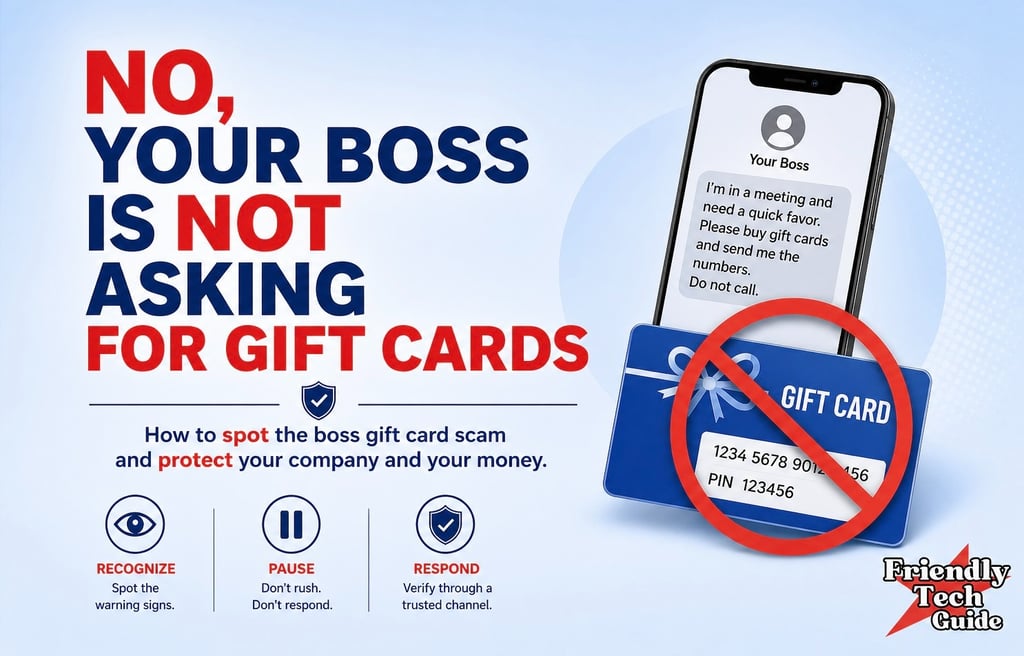
If your boss asks you to buy gift cards and text them the PINs, it is not your boss.
That may sound obvious when you read it calmly. But these scams do not arrive calmly. They usually show up in the middle of a normal workday, when you are busy, distracted, and trying to keep up.
It starts with a simple message. Your phone buzzes with a text or email that appears to come from your manager, the company owner, the CEO, or a high-level director.
"Are you available?" the message asks. "I am in a meeting and need a quick favor."
Because you want to be helpful, you reply. That is when the request arrives.
"I need you to pick up ten $100 gift cards for a client presentation. I will reimburse you by the end of the day. Please send me photos of the back of the cards once you have them."
This is a classic boss gift card scam. It is also a form of business email compromise, sometimes called a boss scam or executive impersonation scam. The message is designed to make you believe that someone with authority is asking you to act quickly, quietly, and outside normal procedure.
How the scam uses workplace culture
This scam works because it exploits three things that exist in almost every workplace: respect for authority, the desire to be helpful, and pressure to respond quickly.
Most employees do not want to ignore a manager. Contractors do not want to look unreliable. Office staff do not want to be the person who delays something important. Scammers understand that, and they build the message around it.
The scammer may say they are in a meeting, on a conference call, traveling, or unable to speak. They may tell you not to call because they are busy or in a quiet room. That instruction is not a small detail. It is the scam.
They do not want you to hear the real person's voice. They do not want you to walk down the hall. They do not want you to check with accounting. They want to keep you inside the text or email conversation where they control the pace.
The request will usually sound urgent but not dramatic. It may be framed as a client gift, an employee reward, a charity donation, an event need, or a last-minute business errand. That is what makes it dangerous. It sounds possible enough to make you pause, but urgent enough to keep you from thinking clearly.
Why gift cards are a warning sign
The biggest red flag is not just that the message claims to be from your boss. The biggest red flag is the payment method.
Gift cards are for gifts, not payments. They are not how a legitimate business pays vendors, rewards clients, reimburses expenses, or handles urgent purchases. A real company has a finance process, a company card, an invoice system, a purchasing account, or an approval chain.
Scammers love gift cards because gift cards work like cash once the numbers are shared. They do not need the physical card. They only need the card number and PIN from the back. Once they have those numbers, they can quickly drain the value.
That is why the scammer asks for photos of the back of the cards. That is the moment the money leaves your control.
Recognize the pressure pattern
A boss gift card scam usually follows a predictable pattern.
The contact appears to come from someone with authority. It may use the person's name, job title, photo, or a lookalike email address.
The request sounds like a favor. The scammer wants you to feel chosen, trusted, or personally responsible.
The request involves gift cards. They may specify the store, the amount, and the number of cards to buy.
The scammer asks for secrecy or speed. They may say not to call, not to bother anyone else, or not to delay.
They ask for the numbers or photos. That is the actual theft.
If all five pieces are present, treat the message as a scam until proven otherwise.
No legitimate company should ask you to use your personal money to buy gift cards for a business purpose, send photos of gift card PINs by text or email, keep a payment request secret from finance, or ignore normal approval procedures.
Pause before you respond
The safest move is not to argue with the message. The safest move is to pause.
Do not go to the store. Do not buy anything online. Do not send a photo. Do not explain why you are suspicious. Do not keep answering questions just because the message seems polite.
Instead, step out of the channel where the request arrived.
If the message came by text, do not verify by replying to that same text. If it came by email, do not verify by clicking reply. If it came through a personal Gmail address or a strange phone number, do not assume the person changed contact methods for convenience.
Use a trusted path that you control.
Call the real person using the number already saved in your contacts or listed in your official company directory.
Use your official company chat system, such as Teams, Slack, or internal email, to ask whether the request is real.
Check with the finance department, office manager, or another supervisor before spending money.
If you are in a small business, walk over and ask in person if possible.
The point is simple: verify through a second channel that the scammer does not control.
What to say without feeling awkward
Some people hesitate because they do not want to seem difficult or disrespectful. But a good workplace should want employees to verify unusual payment requests.
You can keep it professional and simple.
"I received your request about gift cards. Per our security protocol, I need to verify this by phone or through our normal finance process before I can proceed."
Or:
"I am happy to help if this is legitimate. Please confirm through company email or our internal chat before I make any purchase."
Or:
"I cannot send gift card codes by text or email. If this is a real business purchase, I need it routed through the normal approval process."
A real boss will understand. A scammer will usually push harder, become impatient, or disappear.
What if you already bought the cards?
If you bought gift cards but have not shared the numbers, stop immediately. Keep the cards and the receipts. Do not send photos. Contact your manager or finance department and explain what happened.
If you already shared the numbers, act quickly.
Contact the gift card company right away and report the scam. Ask whether the funds can be frozen or recovered. Recovery is not guaranteed, but speed matters.
Tell your bank or credit card company if you used a card to buy the gift cards.
Report the scam to the FTC at ReportFraud.ftc.gov.
If this happened through work email, work chat, or a company device, report it to your employer's IT or security contact.
If business systems may have been compromised, treat it as a possible business email compromise incident.
The simple rule
Recognize the signal: A boss, CEO, manager, or executive asks for gift cards, secrecy, speed, or photos of card numbers.
Pause: Do not buy the cards. Do not send the PINs. Do not stay inside the scammer's communication channel.
Respond: Verify through a known company channel, a direct phone call, the finance process, or another manager.
The RPR Method applies here because this scam depends on momentum. The scammer wants you to move from surprise to obedience without stopping. Your job is to break that momentum.
Read next
The RPR Method: Recognize, Pause, Respond
Closing line
Your boss has a company card, an accounting process, and a finance department for a reason. They do not need gift card codes from you.
CTA
If you found this information helpful, please forward it to someone who could benefit.
Disclaimer
Friendly Tech Guide provides general education and support. We are not a law firm, bank, or government agency. For legal or financial advice, contact a qualified professional. If you believe you are in immediate danger, call local law enforcement.
Sources
Personalized technical assistance at your convenience.
© 2025. All rights reserved.