
The RPR Method: Recognize, Pause, Respond
A simple, repeatable method to stop scams in real time—especially when you feel rushed or stressed. Recognize red flags, pause to create a safety gap, and respond by verifying through a trusted channel.
Friendly Tech Guide
3/1/20264 min read
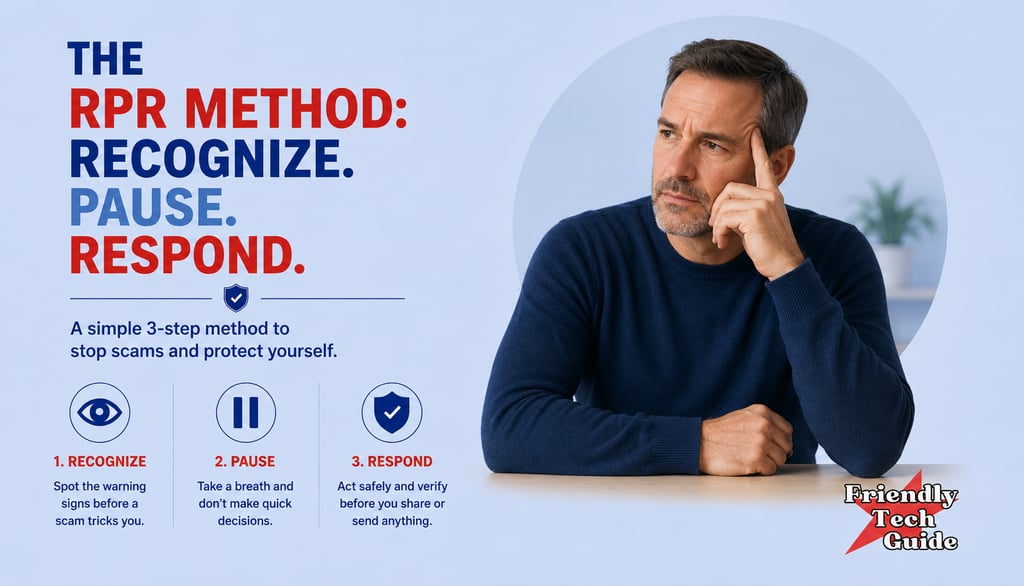
A simple way to stop scams in real time, even when you feel rushed or stressed.
Recognize: Something feels off.
Pause: Stop. Do not click. Do not pay.
Respond: Verify using a number or website you already trust.
If you need help, contact Friendly Tech Guide.
THE 10-SECOND VERSION
Recognize the red flags.
Pause before you act.
Respond by verifying through a trusted source.
If someone is pushing urgency, that is your cue to use RPR.
Ever notice how the moment you slow down, the story starts to fall apart?
WHY RPR WORKS WHEN PANIC KICKS IN
Scammers often rely on speed and emotion. They want you to be rushed, scared, or excited so you act before you think.
A short pause breaks that momentum. Once you slow the moment down, the scam gets harder to hold together.
Scripts remove guesswork. When you know what to say, you stay in control and calm under pressure.
RECOGNIZE: SPOT THE RED FLAGS
If you learn the patterns, most scams become easier to spot.
COMMON RED FLAGS
• Urgency: “Do this now.”
• Secrecy: “Do not tell anyone.”
• Fear: “Your account is locked” or “You will be arrested.”
• Weird payment: gift cards, crypto, wire transfer.
• A new link or a new number you have never used before.
• They want a code you received by text or email.
• They want remote access to your device.
• The story sounds official, but feels off.
A simple Recognize question:
WOULD A REAL BANK, AGENCY, OR COMPANY ASK ME TO DO THIS IN A RUSH?
If the answer is “probably not,” you have enough reason to pause.
PAUSE: CREATE A SAFETY GAP
You do not need to decide right now. You need to slow the moment down.
THE PAUSE PROTOCOL
• Stop talking.
• Do not click anything.
• Do not share codes or passwords.
• Take one breath.
• Say one sentence, then end the contact.
SCRIPT YOU CAN USE RIGHT NOW
“I can’t do this right now. I will verify and call back.”
If they get angry when you pause, that is a sign you are doing the right thing.
RESPOND: VERIFY AND PROTECT YOURSELF
Respond does not mean comply. It means take the next safe step.
THE SAFE VERIFICATION RULE
Only verify using a number or website you find yourself, not what they give you.
Use a trusted path:
• The number on the back of your card
• A statement you already received
• The official app you already use
• A website address you type in yourself (or a bookmark you already trust)
Do not use:
• Any link they sent
• Any QR code they sent
• Any phone number or email address they provided in the message
COPY-AND-PASTE SCRIPTS
PHONE SCAM SCRIPT
“I’m going to hang up and call the company back using the number on my statement or their official website.”
TEXT OR EMAIL LINK SCRIPT
“I don’t use links in messages for account issues. I will log in through the official app or website I access directly.”
FAMILY EMERGENCY SCRIPT
“I love you. I’m calling you back on your normal number now.”
CONTRACTOR OR DISASTER REPAIR SCRIPT
“I will only work with verified contractors. I will check licensing and references before any deposit.”
FOUR COMMON SCAM SETUPS AND HOW RPR STOPS THEM
SCENARIO 1: BANK FRAUD ALERT TEXT
Recognize: urgency plus a link.
Pause: do not click.
Respond: call the bank using the number on your card.
SCENARIO 2: PACKAGE DELIVERY MESSAGE
Recognize: random link and vague tracking.
Pause: do not enter personal info.
Respond: go directly to the carrier's website.
SCENARIO 3: GOVERNMENT THREAT CALL
Recognize: fear, fines, or arrest language.
Pause: hang up.
Respond: verify through official government websites you access directly.
SCENARIO 4: TECH SUPPORT POP-UP
Recognize: scary warning and a phone number.
Pause: do not call.
Respond: close the browser and get real help through official support channels.
WHAT NOT TO DO
Scammers usually want three things:
YOUR SPEED
They want you to act before you think.
YOUR SECRETS
They want codes, passwords, and personal information.
YOUR MONEY PATH
They want a payment method that cannot be reversed.
IF YOU ALREADY CLICKED OR PAID, DO THIS NEXT
First: stop contact. Do not argue. Do not negotiate. End the conversation.
Then:
Stop contact with the scammer
Secure your accounts and devices
Contact your bank or card issuer using official channels
Save evidence: screenshots, numbers, emails, receipts
Start your 24-hour checklist
Read next: What To Do in the First 24 Hours After Fraud:
FAQ:
WHAT IF THEY SAY THEY WILL CLOSE MY ACCOUNT TODAY?
That is a pressure tactic. Use RPR. Hang up and call the company back using the number on your statement, card, or official website.
SHOULD I EVER READ A CODE TO SOMEONE?
Rarely. Codes are commonly used to take over accounts. If someone asks for a code, treat it as a red flag and verify using a trusted number.
HOW DO I KNOW THE REAL NUMBER TO CALL?
Use a number you already trust, like the number on the back of your card, your monthly statement, or the official website you type in yourself.
WHAT IF IT IS SOMEONE I KNOW AND THEIR ACCOUNT GOT HACKED?
Pause and verify through another channel. Call their normal number, or ask a question only they would know. If they refuse, end the contact.
WHAT IF I AM NOT SURE IF IT IS A SCAM?
If you are not sure, that is enough reason to pause. You can always verify safely. Real companies will not punish you for being careful.
SOURCES:
CISA — Recognize and Report Phishing (don’t click suspicious links; report phishing)
FTC — Gift Card Scams (gift cards are for gifts; scammers demand them)
FTC — Cryptocurrency Scams (scammers demand crypto payments)
FTC — Verification Codes (never share one-time codes; anyone asking is a scammer)
FTC — Tech Support Scams (remote-access pressure; fake support tactics)
FBI — Spoofing and Phishing (look up the company’s number yourself; don’t use the number provided)
DISCLAIMER: This is general prevention guidance, not legal advice. If you believe money or accounts are at immediate risk, end the contact and use official channels you can find yourself (for example, your bank’s official support number on your card or statement).
If you found this information helpful, please forward it to someone who could benefit.
Personalized technical assistance at your convenience.
© 2025. All rights reserved.