
The Payment Methods Scammers Push
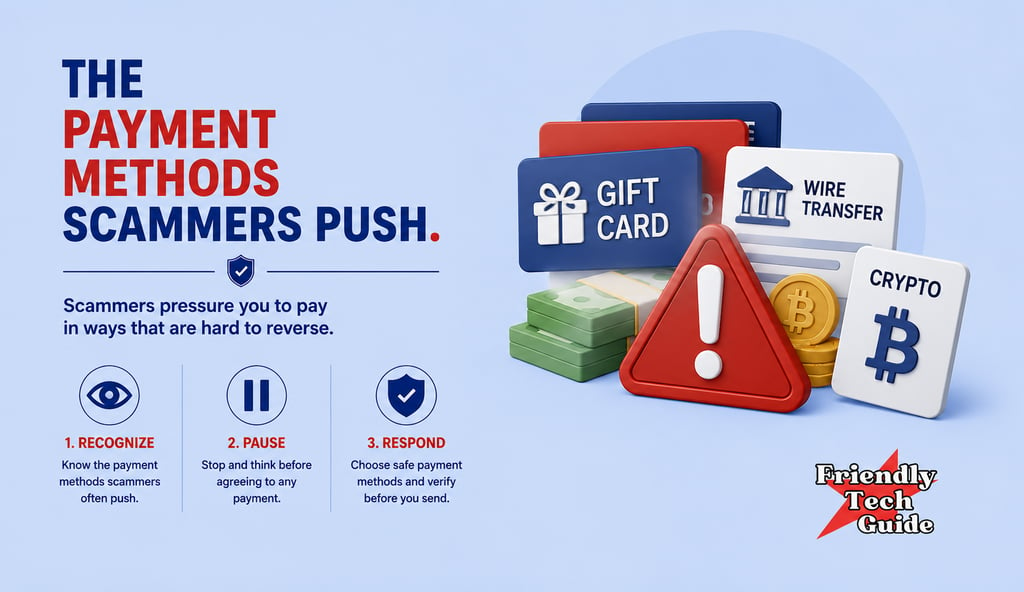
If someone is trying to rush you into a specific payment method, that is not a detail. That is the scam. The payment method is part of the trap.
FRAUD PREVENTIONFFDIPHONE SCAMSSCAM LINKSSCAM PREVENTIONONLINE SAFETYFLORIDA FRAUD DEFENSE INITIATIVEFAMILY SCAM SAFETYGIFT CARD SCAMSSCAM AWARENESSPHISHINGVERIFICATION CODE SCAMS
Friendly Tech Guide
3/4/20263 min read
If someone is trying to rush you into a specific payment method, that is not a detail. That is the scam. The payment method is part of the trap.
Protocol tagline:
Pause. Verify. Do not pay under pressure.
Why payment type matters
Some payment methods are easy to reverse, and some are not. Scammers push the ones that move fast and are hard to recover. They want you to feel like you have no time to think, no time to verify, and no time to choose a safer option.
Here is the rule that keeps you safe:
If they choose the payment method for you, you stop and verify.
Red flag payment requests
You do not need to memorize every scam story. You just need to recognize the money path.
Gift cards
If anyone asks you to pay with gift cards, stop. Legitimate organizations typically do not collect payments this way.
Wire transfers
Wires can be hard to reverse once sent. Scammers use urgency to push you into acting before you verify.
Crypto
If someone asks for crypto because it is faster, safer, or required, treat it as a stop sign.
Instant transfers and peer-to-peer payments
If someone insists you send money through a person-to-person transfer while you are on the phone, stop and verify first.
Cash deposit
If they tell you to deposit cash into a machine or send cash with a courier, stop.
Paying to fix a problem that you did not confirm
This includes taxes, fines, warrants, suspended services, refunds, and account problems. If you did not confirm the issue through an official channel, you do not pay.
The safe alternatives
Safe does not mean perfect. It means you are using a method that gives you time, proof, and a real trail.
Pay through official channels
If it is a real bill or a real company, you should be able to pay by going to the official website you type in yourself, or by calling the official number from your statement or card.
Use your bank bill pay or a check for certain payments
For legitimate bills, paying through your bank or by check gives you a record and slows down impulse decisions.
Use a credit card when appropriate
Credit cards often provide dispute options. That does not guarantee recovery, but it is generally safer than irreversible methods.
Use an invoice and a documented method for services
For a contractor, a service provider, or a business transaction, insist on an invoice that matches the business name, plus a payment method that creates a clear record.
If they refuse safe alternatives, that is the answer
A real company can accept a normal payment path. A scammer usually cannot. If they punish you for verifying or for choosing a safer method, you end the conversation.
The scripts (what to say when they push a payment method)
Use these word for word. Calm tone. Short sentences.
Script 1: stop the pressure
I am not paying right now. I am going to verify this first using an official number.
Script 2: refuse gift cards, crypto, or transfers
I do not pay that way. If this is real, I will handle it through official billing channels.
Script 3: callback rule
I am going to call back using the number on my card or the official website. Goodbye.
Script 4: end the conversation
No. I am ending this call now.
What to do if you have already paid
First, do not panic. Second, act fast and use official channels.
Contact your bank or card issuer using the number on the back of your card.
Ask about stopping or disputing the transaction. Ask what documentation they need.
If you used a transfer service, contact that service through its official app or official website.
Do not use links from messages.
Save evidence.
Take screenshots of messages, emails, receipts, usernames, phone numbers, and any payment details.
Watch for the follow-up scam.
After a payment, scammers often come back pretending to be support or recovery. Treat that as a second scam and verify independently.
If you want a deeper checklist, read: What To Do in the First 24 Hours After Fraud
https://friendlytechguide.com/what-to-do-in-the-first-24-hours-after-fraud
Optional reporting (official channels)
These are common places to report fraud in the United States:
FTC: https://reportfraud.ftc.gov/
FBI IC3: https://www.ic3.gov/
One-page checklist
If they pressure you to pay, stop.
If they choose the payment method for you, stop.
Do not pay with gift cards, crypto, or cash pickup.
Do not stay on the line while moving money.
Verify using a number you find yourself.
If it is real, you can always pay later. If it is a scam, paying now is the loss.
Forward this to one person you care about. The safest payment is the one you do not make under pressure.
If you found this information helpful, please forward it to someone who could benefit.
Disclaimer
This is general information for fraud prevention and response. It is not legal advice. If you believe a crime occurred or you are in immediate danger, contact your bank and local authorities using official contact methods.
Personalized technical assistance at your convenience.
© 2025. All rights reserved.