Verification Codes: The Key You Should Never Share
Scammers ask for verification codes to break into accounts. Learn how to recognize the pressure, pause the conversation, and verify account safety through a trusted path.
FLORIDA FRAUD DEFENSE INITIATIVEFFDIFRAUD PREVENTIONSCAM AWARENESSVERIFICATION CODE SCAMSPHONE SCAMSSMISHINGSCAM PREVENTIONONLINE SAFETYCALLER ID SPOOFINGSCAM LINKSTWO-FACTOR AUTHENICATIONMFAMULTI-FACTOR AUTHENTICATION
Friendly Tech Guide
4/2/20262 min read
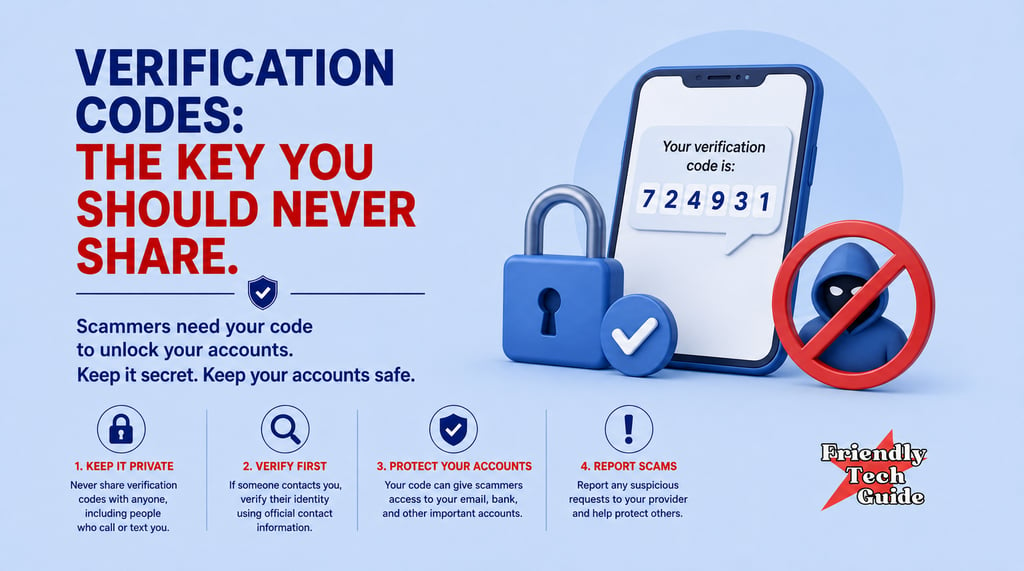
Verification codes are meant to protect your accounts. But when a scammer tricks you into sharing one, that same code can become the key that lets them in.
Why this scam works
The scam often starts with a surprise. A verification code lands on your phone or in your email, even though you were not trying to sign in, reset a password, or verify anything.
Then the contact comes. A caller or texter claims to be from fraud support, account security, or customer service. They tell you there is a suspicious login, a problem with your account, or a charge they need to stop right away.
They ask for the code.
That is the trap.
What the code really does
A verification code is not proof for the caller. It is proof for the account system.
If you read that code to a scammer, you may be handing over the final piece they need to get into your account, reset your password, or lock you out.
Recognize the pressure
If someone contacts you unexpectedly and asks you to read back a verification code, treat that as a major red flag.
Scammers use urgency on purpose. They want you to feel like you must act now to save your account, stop a charge, or fix a problem before it gets worse.
That pressure is the signal.
Pause and verify through a trusted path
You do not need to follow the caller's instructions.
Pause the conversation.
Hang up or stop replying.
Then, verify the situation through a path you control.
Use the official number on your bank card, statement, or the company website that you type in yourself.
Open the official app or website directly instead of using a link from a text or email.
Ask the company whether there is a real issue with your account.
This is the safer move every time.
What to say
You do not have to argue. You only need a short, calm response.
"I do not share verification codes with unexpected callers or messages. I will verify this through the company's official support line myself."
Then end the call or stop replying.
The simple rule
Recognize the signal.
Pause the conversation.
Respond through a trusted path you choose.
Read next:
The RPR Method: Recognize, Pause, Respond
https://friendlytechguide.com/the-rpr-method-recognize-pause-respond
A verification code protects your account only when it stays with you.
If you found this information helpful, please forward it to someone who could benefit.
Disclaimer:
Friendly Tech Guide provides general education and support. We are not a law firm, bank, or government agency. For legal or financial advice, contact a qualified professional. If you believe you are in immediate danger, call local law enforcement.
Sources:
FTC Consumer Alert — What’s a verification code and why would someone ask me for it?
https://consumer.ftc.gov/consumer-alerts/2024/03/whats-verification-code-why-would-someone-ask-me-it
FTC — How To Avoid Imposter Scams
Personalized technical assistance at your convenience.
© 2025. All rights reserved.