
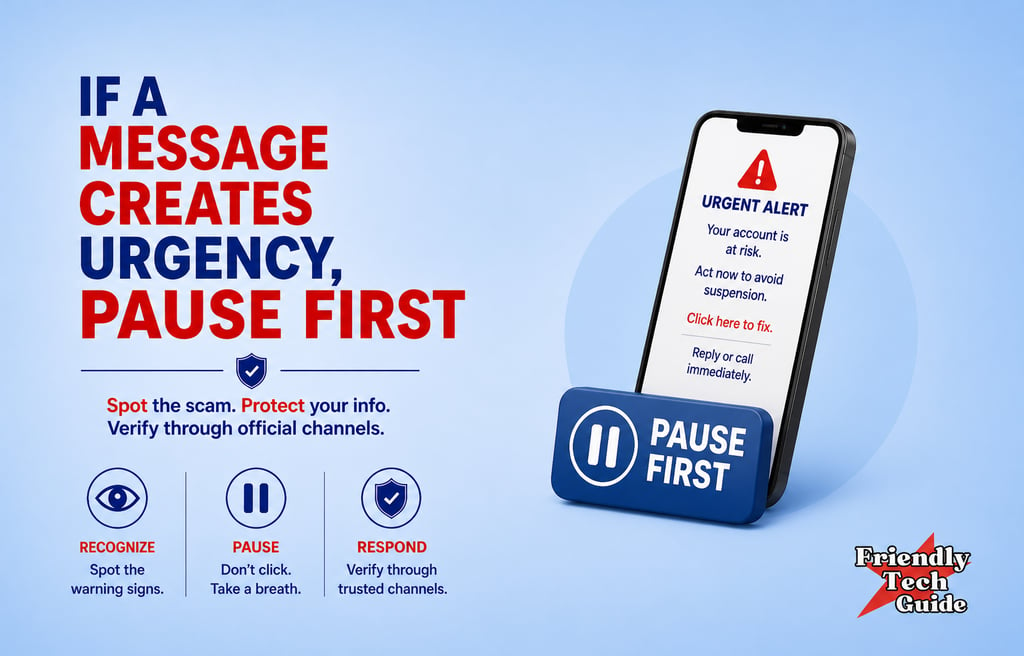
If a Message Creates Urgency, Pause First
Scammers often use urgency to push people into quick decisions. Learn why suspicious messages should make you pause before clicking, calling, replying, or paying.
FLORIDA FRAUD DEFENSE INITIATIVEFFDIPHONE SCAMSSCAM LINKSSCAM AWARENESSFRAUD PREVENTION
Friendly Tech Guide
5/4/20264 min read
The first defense against fraud is refusing to be rushed.
A phone buzzes on the kitchen counter. The screen shows a message warning that a bank account has been locked, an unpaid toll is about to go to collections, or a grandchild has been arrested and needs bail money in the next hour. The wording sounds official. The clock feels real. A finger moves toward the link before the mind catches up. That short stretch of seconds between reading the message and reacting to it is where most scams succeed. Pause in that moment, and the scam usually falls apart on its own.
Scammers do not rely on technical genius. They rely on rush. When someone feels hurried or scared, the brain skips the steps it would otherwise use to confirm a message. The Federal Trade Commission's scam guidance repeatedly points readers to the same warning signs: unexpected contact, pressure, impersonation, and payment requests that feel out of the ordinary. The FBI built a national awareness campaign called Take A Beat around exactly this idea. Real institutions can wait a few minutes. Criminals cannot.
Why Urgency Works
The behavioral rule that follows is simple. Urgency should trigger caution, not compliance. The first safe move is to pause. Step away from the screen for two minutes. Set the phone face down. Walk to the next room. The pressure was the scam's fuel. Take that fuel away, and most of the threat goes with it.
Examples are everywhere because the same playbook gets reused. A text claims that a bank account has been locked due to a suspicious login and demands an immediate click to reactivate it. Another says an unpaid toll will be sent to a collections agency unless a small fee is paid through a link by midnight. A version of the same trick arrives as a phony DMV warning about a court date or a suspended license. A worker at a small business gets a text from someone claiming to be the boss, asking for help with a quick favor, often gift cards bought on the way back from lunch. A late evening call says a power or water bill is past due, and the service will be shut off within the hour unless a payment is made through a prepaid card or transfer app. A voice claiming to be a police officer or court clerk threatens an arrest warrant unless a fine is paid right now. A panicked call says a family member has been in an accident or has been jailed and needs money sent immediately, and please do not tell anyone else. Each story is different. The mechanics are identical: a real-sounding problem, a narrow time window, an unusual payment channel, and instructions that ask the reader to skip every normal verification step.
The family emergency version is among the most painful because it weaponizes love. The FTC notes that scammers fake emergencies precisely because they know a frightened parent or grandparent will reach for the phone before reaching for facts. The same advice applies whether the message is on a screen or in a voice on the other end of the line. Hang up, take a breath, and call the family member or a known contact directly using a number already saved in the phone, not a number provided by the caller.
Texts and robocalls give scammers volume. They can send millions of messages in an afternoon, and even a tiny response rate is profitable. The FCC's guide to unwanted robocalls and texts advises readers to exercise caution with suspicious calls and messages. For a message that looks like a scam, the safer move is not to engage with it. Do not click. Do not answer questions. Do not use the contact path provided in the message. Delete, block, and report when appropriate.
Gift cards deserve a category of their own. No legitimate agency, employer, court, or utility ever asks for payment in gift cards. The FTC warns clearly that any request to pay with gift cards is a scam. If a message of any kind, official or personal, ends in a request to walk into a store, buy gift cards, scratch off the back, and read the numbers aloud or send a photo, the answer is no, every time, without exception.
What Pausing Looks Like
What pausing actually looks like in practice is straightforward. Do not click the link in the message. Do not call the number printed in the message. Do not reply with an account number, a code, a password, or any personal detail. Verify, through a path that the scammer does not control. Use a printed bill, the number on the back of a credit card, the agency's main number found through a separate search, or the official app already installed on the phone. If something genuine is wrong, the trusted channel will know. If nothing is wrong, the pause costs nothing.
The habit is the protection. Pause First is not a slogan. It is a few quiet seconds traded for the rest of an account, a savings balance, or a sense of safety. The next time a message tries to set the clock, set it down instead.
Read Next
The RPR Method: Recognize, Pause, Respond
What To Do Before You Click: A Simple Scam Safety Checklist
If you found this information helpful, please forward it to someone who could benefit.
Disclaimer: This article is for general education only. It is not legal, financial, cybersecurity, or law enforcement advice. If you believe you have been targeted by a scam, contact your bank, the appropriate agency, or local law enforcement as needed.
Sources and Further Reading
Personalized technical assistance at your convenience.
© 2025. All rights reserved.