Before You Click "Pay": A Simple Bill-Verification Rule for Families and Businesses
Unexpected bill, renewal notice, toll charge, or payment link? A fake bill does not have to fool everyone. It only has to reach one rushed person at the wrong moment. Here is a simple rule families and businesses can use before a
Friendly Tech Guide
6/3/20265 min read
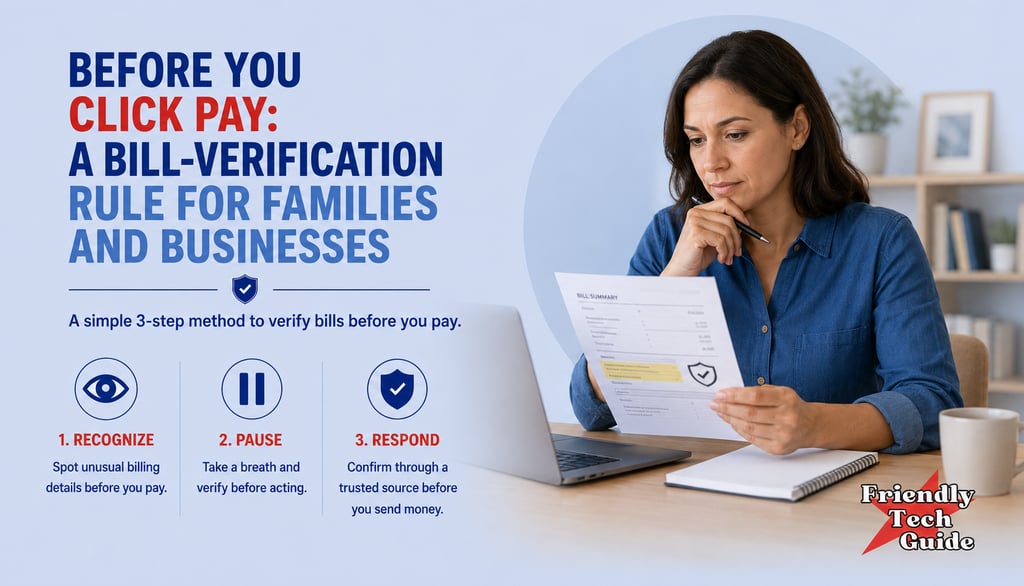
A fake bill does not have to fool everyone. It only has to reach one rushed person at the wrong moment. That is the whole design. An unexpected invoice, a renewal notice, a toll charge, a subscription warning, or a payment link shows up, looks ordinary enough, and asks for money before anyone has time to think.
This is not a reason to be afraid of every bill. Most bills are real. It is a reason to add one small step before money moves. The step is simple, it works for households and for businesses, and it does not depend on spotting a perfect fake.
The rule is this. Before you pay for an unexpected request, verify it through a second channel you already trust.
The Trigger: An Unexpected Request to Pay
It usually starts with something that lands without warning. An invoice for a service you do not remember ordering. A renewal notice for software or a membership. A text that says you owe a small toll. A message that a subscription is about to be charged to you. An email stating that an account has an issue and requires a payment to resolve it.
The Federal Trade Commission has warned that scammers send fake invoices to businesses for products and services they never ordered, sometimes stamped with a past due notice to add pressure. The FBI Internet Crime Complaint Center has tracked a wave of text messages claiming people owe money for unpaid road tolls. The details change. The shape is the same. An unexpected request to pay.
An unexpected request is not proof of a scam. It is simply a signal to slow down.
The Pressure: Why It Feels Urgent
The next thing these messages do is make payment feel urgent. The notice says the balance is overdue. The text warns of a late fee. The email says an account will be closed or a service will stop. Some messages add a deadline measured in hours.
The FTC describes this pattern plainly. Scammers create a sense of urgency, then pressure you to act immediately before you have time to check the story. Urgency is the tool. It is meant to move you from reading to paying without pause.
A safer rule is to treat urgency itself as a reason to slow down, not speed up. A real company will let you confirm a bill. Pressure to pay right now is a signal, not an instruction.
The Trap: The Path the Message Hands You
Every one of these messages comes with a path already built in. A link to a payment page. A QR code to scan. An attachment to open. A phone number to call. A reply that sends your details straight back to the sender.
That built-in path is the trap. It feels convenient because it is right there. But it is the one part of the message you cannot trust, because it was chosen by whoever sent it. If the message is fake, the link, the number, and the portal are fake too, and they are designed to look real.
The FTC guidance on this is direct. Do not click links or call numbers in an unexpected message. If you think the message might be real, reach out to the company another way. The point is not that every link is dangerous. The point is that the link inside a message you did not expect is the wrong way to check whether that message is true.
The Rule: Verify Through a Trusted Second Channel Before Money Moves
Here is the single rule that ties it together. Before money moves, verify the request through a second channel you already trust.
A trusted second channel is a way to reach the company that is not via a suspicious message. The phone number is printed on your paper statement or on the back of your card. The official website you type in yourself. The account you log into directly. The vendor contact your business already has on file. A family member you can call to ask.
This is the same advice the FTC gives for verification codes and imposter calls. Contact the company using a number or website you know is legitimate, and never use the contact information in the message provided. It is the advice the FBI gives businesses about payment requests. Confirm using a previously known phone number, not the one in the email, and use more than one channel for anything that moves money. It is what the FBI told people facing toll texts. Check your account on the toll service's real website, and call its real customer service line.
For a household, that might look like this. A text says a toll is unpaid. Instead of tapping the link, you open the toll agency's official site yourself and check your account there. This is an example, not a real notice, but the move is the one that matters. You chose a path, not the one the text provided you.
For a business, it might look like this. An invoice arrives for a renewal. Before anyone approves it, a second person checks it against known vendors and confirms by calling a number already on file. Again, an example. The habit is what protects the payment. A known channel, a second set of eyes, and a confirmation before money moves.
One more piece fits here. If anyone asks for a verification code that was texted to you, do not share it. The FTC is clear that anyone who asks you for your account verification code is a scammer. A legitimate company will not unexpectedly contact you and ask you to read back a verification code to confirm a bill.
The Habit: Make It a Standing Payment Rule
A single good catch is helpful. A standing rule is better. The goal is to make second-channel verification something the household or the business does every time, not something you remember only when a message feels off.
In a household, that can be one agreement. Any unexpected request to pay gets checked through a known channel before anyone sends money. In a business, it can be a simple written step in how invoices and payment changes are approved. Unexpected or changed payment requests are confirmed by a known contact or a second person before payment.
This connects to habits Friendly Tech Guide has covered before. Pause when a message creates urgency. Be careful with QR codes and payment links. Treat a familiar voice as something to verify, not to trust on its own. Bill verification is the same instinct applied to the moment money is about to move.
The Simple Rule
An unexpected bill is not proof of fraud. Urgency is not proof. A convincing logo is not proof. The link inside the message is not proof.
The proof reaches the company through a channel you already trust before any money moves.
Decide on that rule today, for your household or your business, so it is already in place the next time an unexpected bill arrives.
If this helped, send it to someone who pays bills for a household, family member, or small business.
Read Next:
The Fake Invoice Scam: Why Small Businesses Pay Bills They Never Owed
That Panicked Call May Not Be Your Family: How AI Voice Scams Work
Sources:
Federal Trade Commission, Run a small business? Pay your bills, not scammers
Federal Trade Commission, What is a verification code and why would someone ask me for it?
Report scams to the FTC at ReportFraud.ftc.gov and to the FBI at IC3.gov.
Disclaimer: Friendly Tech Guide provides general education and support. It is not a law firm, bank, government agency, cybersecurity firm, or law enforcement agency. If you believe you are in immediate danger, contact local law enforcement. If money, accounts, or identity information may be involved, contact your bank, the relevant company, or a qualified professional.
Personalized technical assistance at your convenience.
© 2025. All rights reserved.