
That Panicked Call May Not Be Your Family: How AI Voice Scams Work
A familiar voice on the phone is no longer proof of who is calling. Scammers can clone a loved one's voice from a short clip and use it to pressure a household into making a quick decision. The fix is not better listening. The fix is a household rule decided before the call ever comes.
Friendly Tech Guide
5/21/20265 min read
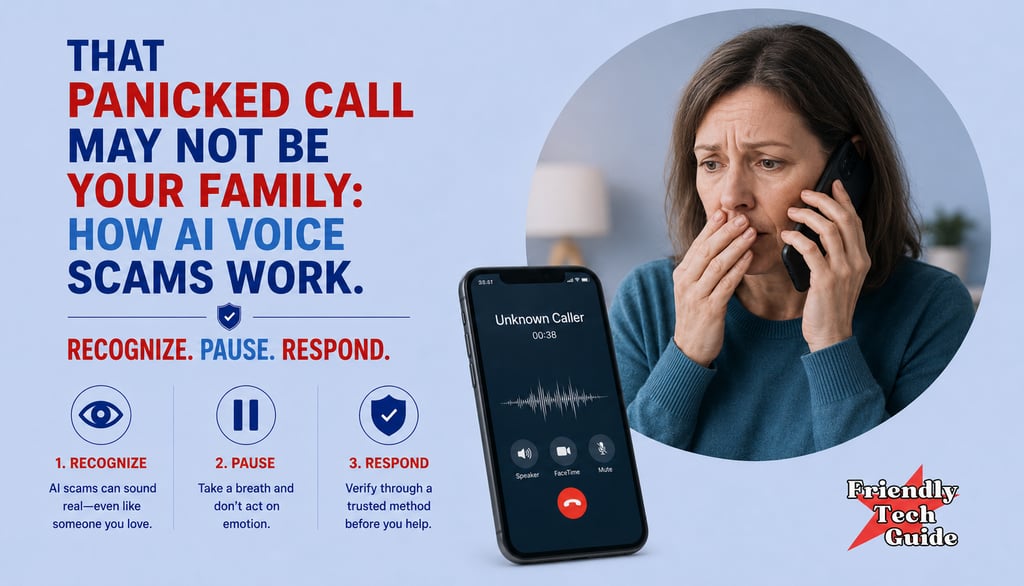
A familiar voice is no longer proof. Set one household rule before the emergency call comes.
The phone rings. The voice on the other end says it is your grandson, your daughter, your nephew. They are scared. There has been an accident, an arrest, a hospital, a problem they cannot tell anyone else about. They need money fast. And it sounds like them.
Most people's first thought is to help. That is exactly what the scammer is counting on. A familiar voice used to be one of the strongest signals that a call was real. With AI voice cloning, that is no longer true.
What AI Voice Cloning Actually Is
AI voice cloning uses a short clip of someone's voice and software to generate new speech in that same voice. The FTC has warned consumers that a scammer only needs a short audio sample, often taken from online content, to produce a believable copy of a loved one's voice.
That changes the math on family emergency scams. The grandparent scam used to depend on a caller who could imitate or simply hide behind a poor connection. Now, a scammer can place a call that actually sounds like your family member.
This is not a reason to panic. It is a reason to update one rule in your household.
Why Familiar Voice and Caller ID Are Not Proof Anymore
Two things used to make a panicked call feel real. The voice. And the number on your screen.
Both can be faked.
The voice can be cloned from short clips found in public posts and videos. Caller ID can be spoofed so the call appears to come from a name or number you already trust. The FCC has issued public guidance that spoofing technology lets a caller falsify the information shown on your caller ID, and it has applied robocall rules to AI-generated voice calls under the Telephone Consumer Protection Act.
A scam call can sound like your family member, show a familiar number, and arrive at the worst possible moment. None of that is proof.
What is proof is reaching the real person through a channel you already control.
How the Scam Usually Plays Out
The pattern is steady, even when the voice is convincing.
A panicked caller says they are in trouble. There is often a second voice on the line claiming to be a lawyer, a police officer, or a doctor. The story includes urgency, secrecy, and a specific way to send money fast. Wire transfer. Cryptocurrency. Gift cards. A payment app. Sometimes a courier is sent to the house.
The FBI Internet Crime Complaint Center has warned that scammers in grandparent schemes ask for funds by wire, mail, or in-person couriers, and pressure victims to keep the situation secret. The FTC describes the same playbook for family emergency scams: urgency, secrecy, and a payment method that is hard to reverse.
If the call meets all three criteria, treat it as a scam until verified.
The Household Rule, Decided Before the Call Comes
The single most effective defense is a rule the household agrees on before anything happens. The rule is short, and it does not depend on how well anyone listens.
If any family member ever calls or sends a message claiming to be in trouble, the household does the same thing every time.
End the call, or set the phone down and stop responding.
Reach the real person back through a known channel saved before the call. Use a number already in your phone, an email already in your contacts, or a trusted family contact who can confirm what is happening.
Do not use the number that just called.
Do not use a number, link, or contact supplied by the caller.
Do not send money, share information, or confirm details until the real person is reached through that known channel.
That is the main rule. Independent verification through a trusted channel is the part that actually defeats voice impersonation.
A code phrase can be added as an optional backup. Some households choose a short word or phrase that the real family member will say if asked. It is not foolproof. A determined scammer can fish for it, family members forget it, and a stressed person on a real emergency call may freeze. Treat a code phrase as one extra signal, not as proof. If a caller cannot give the code phrase, that is one more reason to stop. If a caller does give a code phrase, that is not enough on its own. Verify through the known channel anyway.
Short Script You Can Use in the Moment
Plain words. Calm tone. Short sentences.
"I am going to hang up now and call you back on the number I already have."
"I need to verify this on my end before I do anything."
"I will call your mother before I send anything."
If the caller pushes back, that is the answer. A real family member in real trouble will accept being verified. A scammer will try to keep you on the line.
What Not to Do
Do not send money during the call.
Do not stay on the line while you try to verify. The pressure works because you are still listening.
Do not redial the number that just called. That can route you back to the scammer.
Do not trust the caller ID alone. It can be spoofed to look familiar.
Do not share new details with the caller. Confirming a name, a relationship, or a story gives the scammer more material for the next call.
Do not keep it secret. The demand for secrecy is part of the scam, not part of the emergency.
If the Call Has Already Happened
If you sent money or shared information, act quickly and through official channels.
Contact your bank or card issuer using the number on the back of the card.
If you used a transfer service or a payment app, contact it directly through its official site or app.
Save screenshots, voicemails, and any phone numbers or payment details.
Report the scam to the FTC at ReportFraud.ftc.gov and to the FBI Internet Crime Complaint Center at IC3.gov.
Then tell the household. Update the family verify rule based on what happened. Watch closely for follow-up calls offering to help recover the money. Recovery scams target people who have already lost money once.
The Simple Rule
A familiar voice is not proof. Caller ID is not proof. Urgency is not proof.
The only proof is reaching the real person through a channel you already control.
Decide on that rule with your household today, before the call comes.
Read Next:
The 15-Minute Family Scam Safety Check. Verified live: https://friendlytechguide.com/the-15-minute-family-scam-safety-check
If a Message Creates Urgency, Pause First. Verified live: https://friendlytechguide.com/if-a-message-creates-urgency-pause-first
How to Verify Any Call or Text Without the Risk. Verified live: https://friendlytechguide.com/how-to-verify-any-call-or-text-without-the-risk
If you found this information helpful, please forward it to someone who could benefit.
Disclaimer: Friendly Tech Guide provides general education and support. It is not a law firm, bank, government agency, cybersecurity firm, or law enforcement agency. If you believe you are in immediate danger, contact local law enforcement. If money, accounts, or identity information may be involved, contact your bank, the relevant company, or a qualified professional.
Sources:
Federal Trade Commission, Scammers use AI to enhance their family emergency schemes: https://consumer.ftc.gov/consumer-alerts/2023/03/scammers-use-ai-enhance-their-family-emergency-schemes
Federal Trade Commission, Scammers Use Fake Emergencies To Steal Your Money: https://consumer.ftc.gov/articles/scammers-use-fake-emergencies-steal-your-money
Federal Trade Commission, Fighting back against harmful voice cloning: https://consumer.ftc.gov/consumer-alerts/2024/04/fighting-back-against-harmful-voice-cloning
Federal Trade Commission, Family Emergency Scams: https://consumer.ftc.gov/all-scams/family-emergency-scams
Federal Bureau of Investigation Internet Crime Complaint Center, FBI Warns of Scammers Targeting Senior Citizens in Grandparent Scams and Demanding Funds by Wire, Mail, or Couriers, Alert Number I-111723-PSA, November 17, 2023: https://www.ic3.gov/PSA/2023/psa231117
Federal Communications Commission, Caller ID Spoofing: https://www.fcc.gov/consumers/guides/spoofing
Federal Communications Commission, FCC Makes AI-Generated Voices in Robocalls Illegal (Declaratory Ruling FCC 24-17, February 8, 2024): https://www.fcc.gov/document/fcc-makes-ai-generated-voices-robocalls-illegal
Report scams to the FTC at ReportFraud.ftc.gov and to the FBI at IC3.gov.
Personalized technical assistance at your convenience.
© 2025. All rights reserved.