
The 15-Minute Family Scam Safety Check
Use this 15-minute family scam safety check to help your household recognize pressure, pause before reacting, and respond through trusted channels.
FLORIDA FRAUD DEFENSE INITIATIVEFFDISCAM AWARENESSFRAUD PREVENTIONSCAM PREVENTIONFAMILY SCAM SAFETYPHISHINGPHONE SCAMSONLINE SAFETYSMISHING
Friendly Tech Guide
5/11/20266 min read
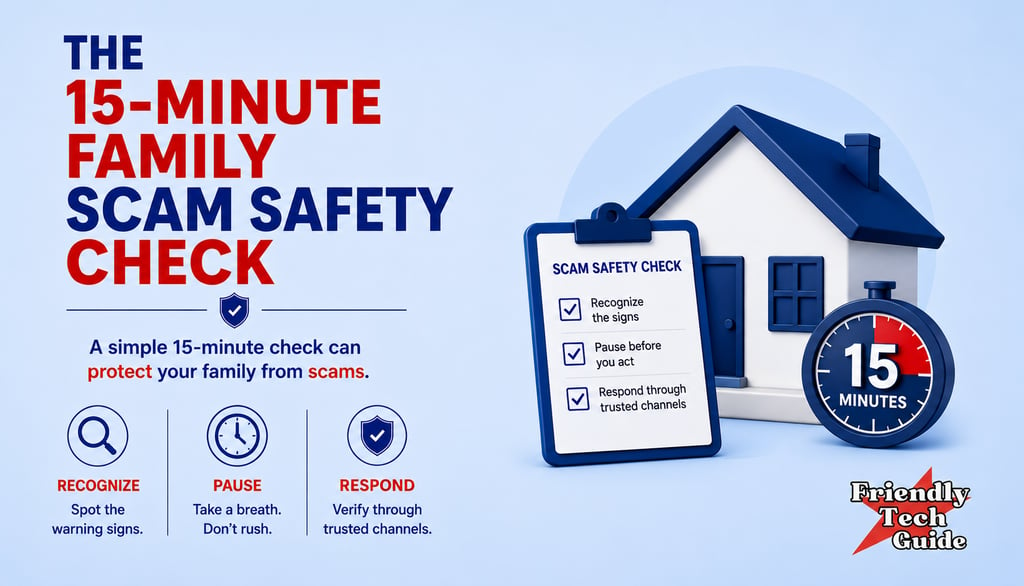
A simple household routine for spotting pressure, slowing down, and verifying before anyone clicks, replies, pays, or shares information.
A parent gets a text saying the bank has locked the account. A grandparent gets a call from someone claiming a grandchild is in jail and needs bail money before the end of the day. A worker gets a message from someone using the boss's name asking for help with a quick favor. The stories are different, but the shape is the same. Someone in the family is contacted alone, under pressure, with a clock running, and no one else in the house knows what is happening yet.
Most families know scams exist. Most families do not have a shared plan for what to do when one shows up. The good news is that a working plan does not need to be technical, expensive, or complicated. It needs to be short, simple, and practiced once before the next urgent message lands.
This article walks through one. Fifteen minutes at the kitchen table is enough to set it up.
Why a 15-Minute Routine Matters
Scammers do not rely on technical brilliance. They rely on rush. They want one person, alone, surprised, scared, and moving fast enough to skip the steps that would normally catch the trick. The Federal Trade Commission describes the same four warning signs over and over again: someone pretending to be an organization you know, a problem or prize that demands immediate action, pressure to act right now, and a request to pay through unusual channels such as gift cards, wire transfers, payment apps, or cryptocurrency.
The defense is not new technology. It is a shared routine that the household has agreed to in advance. A family scam safety check uses a single, simple framework: Recognize the pressure. Pause before acting. Respond through a trusted path. That is RPR. It is the same idea behind the FBI's national fraud awareness effort, Take A Beat, which urges the public to resist pressure to act quickly, pause for a moment, and assess the situation before doing anything else.
The routine below takes about fifteen minutes. Run it once at a calm moment, write it down somewhere everyone can find it, and run it again twice a year.
Minutes 1 to 3: Name the Warning Signs Out Loud
Spend the first three minutes naming the warning signs the household should treat as suspicious by default. Keep the list short and plain.
Common pressure cues to call out: urgency, fear, secrecy, unexpected contact, a link, a callback number printed inside the suspicious message, a demand for payment, a request for gift cards, wires, cryptocurrency, or payment apps, a code sent by text that someone is trying to talk you into reading aloud, a caller who tells you not to hang up, a message that asks you not to tell anyone else.
If a message or call has any two or three of these in the same breath, the family treats it as suspicious until proven otherwise. The FTC's phishing guidance and CISA's guidance on recognizing phishing describe the same pattern across emails, texts, and calls.
Minutes 4 to 7: Pick the Household Pause Rule
The next four minutes are for the simplest part of the routine. The household agrees on one rule for every urgent message, no matter how real it sounds.
Nobody in the family clicks, replies, calls back, pays, or shares information from an urgent message before pausing and checking through a trusted channel.
That is the whole rule. It does not require a technical decision. It does not require knowing whether a particular link is fake. It requires only that the family agrees, in advance, that urgency by itself is not proof of anything. RPR fits inside the pause. Recognize the pressure. Pause before acting. Respond through a trusted path that the message did not provide.
If someone in the family follows this rule and the message turns out to be real, almost nothing has been lost. A bank, a hospital, a school, or a legitimate agency can absorb a five-minute pause. A scam cannot.
Minutes 8 to 11: Choose Trusted Channels Before You Need Them
This is the most useful part of the routine. Most people only think about trusted channels in the middle of a panic. By then, it is too late. Spend four minutes deciding, in advance, where the family will verify things.
Examples of trusted channels worth listing: the phone number printed on the back of a bank or credit card; the official app for the bank, utility, or shipping company already installed on the phone; a printed bill or statement that came through the mail; a family member's saved contact in the phone, not a number that came in with the suspicious message; a caregiver's known direct line; an agency's main website typed directly into the browser, not a link from a text; the local non-emergency police line for situations that involve threats or claims of arrest.
Write the short list down. Put it on the fridge, in a shared note on the family's phones, or on a small card kept near the landline if there is one. The FCC's guidance on unwanted robocalls and texts and the U.S. Postal Inspection Service's guidance on package tracking smishing scams point in the same direction. Verify through a path you already trusted before the suspicious message arrived.
Minutes 12 to 15: Make the Household Agreement
The last three minutes are for writing down a short family agreement. Six lines are plenty.
Who in the family gets called first when something feels off, before any link is clicked? What payment methods does the family never use in response to a message, including gift cards, wire transfers, cryptocurrency, and payment apps sent to unknown people? What information the family never shares in response to a message, including account numbers, Social Security numbers, one-time codes, and passwords. What to do with suspicious texts: do not reply, do not click, screenshot if useful, then delete and block. Where to report scams, including ReportFraud.ftc.gov for federal reporting, IC3.gov for the FBI, 7726 for forwarding suspicious texts, and the gift card company directly if a gift card was involved. What to do if someone in the family has already clicked, paid, or shared information, including a same-day call to the bank if money or account information was involved, a visit to IdentityTheft.gov if identity information was shared, and a call to a trusted family member or caregiver so the person is not handling it alone.
That last line matters more than the rest combined. The FTC's guidance on fake emergency scams is clear about why. Scammers count on isolation, and they often tell the target to keep it a secret. Anyone who has already been pressured by a scammer is in the worst possible state to handle the recovery alone.
What Not to Do
Keep a short list of things the family does not do, no matter how convincing the message sounds.
Do not click links in urgent messages. Do not call the phone number printed inside a suspicious message. Do not reply with verification codes, account numbers, or passwords. Do not buy gift cards to pay anyone who contacted you first. The FTC is direct on that point: any request to pay with gift cards is a scam. Do not stay on the line with a caller who is threatening arrest, deportation, or account closure. Do not keep an urgent message secret from the rest of the household. Do not assume a familiar name proves a message is real. Do not trust caller ID by itself.
These are not opinions. They are consistently repeated across the official guidance from the FTC, the FCC, the FBI, CISA, and the U.S. Postal Inspection Service.
A family scam safety plan does not need to be complicated. It needs to be agreed on once, written down somewhere everyone can find it, and used the next time the phone tries to set the clock.
Read Next:
If you found this information helpful, please forward it to someone who could benefit.
Disclaimer: Friendly Tech Guide provides general education and support. It is not a law firm, bank, government agency, cybersecurity firm, or law enforcement agency. If you believe you are in immediate danger, contact local law enforcement. If money, accounts, or identity information may be involved, contact your bank, the relevant company, or a qualified professional.
Sources:
Federal Trade Commission, Scammers Use Fake Emergencies To Steal Your Money
Federal Trade Commission, Avoiding and Reporting Gift Card Scams
Federal Trade Commission, How To Recognize and Avoid Phishing Scams
Federal Communications Commission, Stop Unwanted Robocalls and Texts
U.S. Postal Inspection Service, Smishing: Package Tracking Text Scams
Personalized technical assistance at your convenience.
© 2025. All rights reserved.